
Good systems don't happen by accident. they're engineered!
Dr. Natasha P. Wilson, Operations & Systems Architect, helping growing tech-forward companies build scalable, elegant workflows.
Core Competencies
Operational Excellence & Systems-Level Leadership
I bring clarity, structure, and long-term thinking to growing organizations by:
Transforming fragmented operations into calm, repeatable systems that scale.
Removing hidden bottlenecks before they become performance or credibility risks.
Establishing the SOPs, systems, and rhythms that create predictability.
Systems Architecture & Workflow Engineering
I design scalable, elegant systems that eliminate chaos and create clarity by:
Translating business complexity into elegant data workflows.
Aligning cross-functional teams around one coherent technical plan.
Building cloud-native systems that are reliable, transparent, and easy to maintain.
Technical Strategy & Cross-Functional Translation
I bridge engineering, operations, and business needs into coherent, executable systems by:
Translating business needs into clear, functional technical workflows.
Turning scattered requirements into one integrated system design.
Keeping cross-functional teams aligned and moving together.
Bringing coherence to tools, data flows, and processes.
About Natasha P. Wilson, Ph.D.
Operations & Systems Architect
B.S. Chemical Engineering, UMBC, 2005
Ph.D., Chemical and Biochemical Engineering, UMBC, 2016
I’m an operations & systems architect trained as a chemical and biochemical engineer.
I help companies solve complexity through clarity, structure, and elegant system design.
My work combines engineering rigor, analytical depth, and calm operational leadership to help teams grow without burnout or chaos.
The Engineered Insight Framework
Systems-Level Diagnostics for Fast-Growing Teams
Most operational problems aren’t people problems.
They’re systems problems.The Engineered Insight Framework brings engineering rigor, data-driven analysis, and organizational clarity to uncover the bottlenecks, failure modes, ownership gaps, and low-leverage work that hold teams back.Through a structured approach, you receive a clear, actionable blueprint of where your system is breaking down and exactly where to focus next.
What Leaders Gain From The Engineered Insight Framework
Who Owns It?
Align roles, decisions, and accountability across teams.Where Does It Hurt?
Pinpoint the bottleneck slowing your entire operation.Where Does It Break?
Map the failure modes that put your system at risk.Where Are the Opportunities?
Focus on the highest-leverage actions for maximum impact.
Get your free Ownership Risk Index.
See your top 3 opportunities to regain capacity by clarifying and delegating ownership—delivered straight to your inbox.
The Result: The Engineered Insight Report
A concise, executive-ready systems diagnosis that highlights:
your highest-leverage opportunities
your biggest operational risks
your most impactful next steps
a path toward scalable, elegant workflows
Built for Teams That Are Growing Faster Than Their Systems
This diagnostic is ideal for:
Small companies ready to scale
Operations leaders under constant pressure
Cross-functional teams navigating complexity
If your organization feels stuck, inconsistent, or overwhelmed,
you don’t need more effort ,
you need better systems.
Connect with me to get started with your Engineered Insight Diagnostic today!
Let's Build Together!
If your company or organization is interested in working with Dr. Wilson, fill out the form below.
Is Your Company Growing — But Only As Fast As You Can Work?
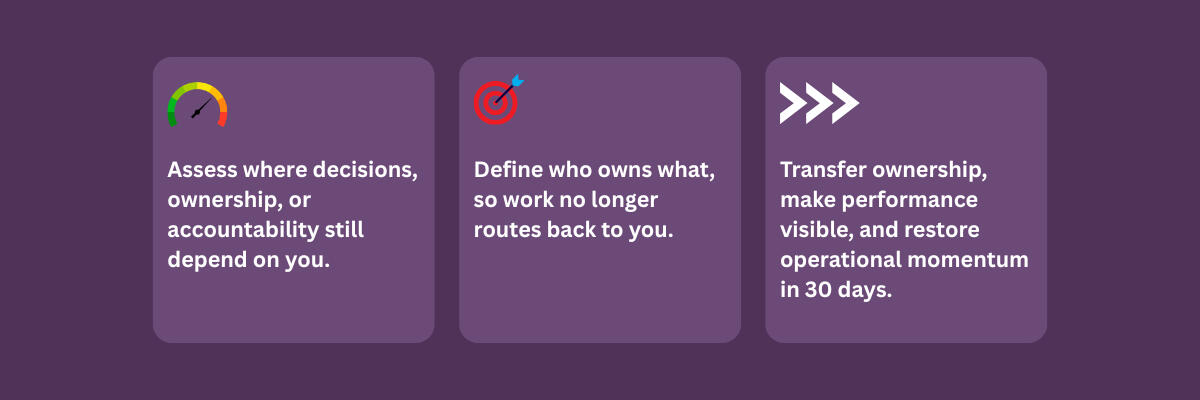
Become the Unconstrained Founder, where growth is no longer capped by your personal bandwidth.When clarity, approval, and accountability default to you, growth requires more hours, more decisions, more escalation.That is not a motivation problem.
It is a structural one.The Who Owns It? diagnostic reveals where execution is founder-dependent.
The 30-day plan transfers ownership and removes that constraint.
Designed for founder-led teams (5–50 people). Based on systems and constraint thinking
The Engineered Insights Framework: Who Owns It?
An Ownership Risk Diagnostic for Founder-Led Companies Scaling Beyond Direct OversightIf you’re the person your team relies on to solve problems, make final calls, or quietly “make things work,” your company’s capacity is likely tied to your personal bandwidth, which puts a cap on scale by definition.Who this is forThis diagnostic is designed for founders, business owners, or CEOs of small, growing companies where work has begun to cross role, functional, or accountability boundaries. It is most useful once there is a team in place (employees, contractors, or functional leads), and ownership is no longer purely intuitive and informal oversight is no longer sufficient.As companies grow, more and more critical work accumulates on the founder’s plate. At first, this feels efficient. As business complexity increases, this quietly becomes a bottleneck.Who Owns It? helps you identify where the needs of your business have outstripped your capacity for direct oversight, so you can deliberately redesign ownership before growth turns into drag.Here, ownership means clear authority and accountability for decisions and outcomes in a defined area of the business.This diagnostic does not assume that responsibilities should always be delegated away from the founder.What your results highlightYour responses generate a short Ownership Risk Summary (sent by email) that highlights:* Where responsibility or decision-making still routes back to you
* Which areas are most likely to keep pulling you into firefighting
* What type of ownership redesign would reduce pressureThis is not an evaluation of your leadership or your team.
It’s a snapshot of how authority and responsibility are currently routed, and where that routing exhausts your capacity.How to respondRate each statement using the scale below, based on how critical the responsibility is and how sustainable it would be for you, as founder, business owners, or CEO, to continue owning it as it is currently structured.1 — Sustainable: Works without special effort
2 — Manageable: Works with periodic oversight
3 — Increasingly difficult: Requires growing attention
4 — Not sustainable long-term: Relies on informal fixes
5 — Actively limiting capacity or growth: Breaks without founder involvementAnswer each prompt based on the real, day-to-day experience of you and your team, not how things should work in theory.Growth naturally creates strain in ownership and decision routing. This diagnostic identifies where that strain is showing up, and which structural interventions are most likely to reduce it.Smooth, scalable organizations don’t emerge by chance. They’re engineered.A note about privacyYour responses are used to generate your Ownership Risk summary and may be anonymized and aggregated for insight purposes. Your individual responses will not be sold or shared with third parties.
Thank you! Your response has been recordedWhat this diagnostic does (and does not) doThis diagnostic does not tell you who on your team should own these responsibilities yet.It shows which responsibilities can no longer remain implicitly founder-owned and highlights ownership patterns that typically reduce risk at this stage.For solo founders, higher scores may signal areas to monitor or intentionally design for the future, even if no immediate change is possible.Designing safe handoffs, authority boundaries, and role definitions comes next.
OWNERSHIP RISK REFERENCE GUIDE
How to interpret ownership risks surfaced in your diagnostic
Version 1 - 2/7/2026
Purpose
This reference explains how each ownership risk is defined and how to interpret high scores. It is intended to clarify meaning, not prescribe solutions.
Ownership Risk: Decision Authority
Decision Authority refers to how decisions are made, documented, and communicated across the organization.
What a High Ownership Risk Signals
Decisions live primarily in the founder’s or leader’s head
Decisions are revisited or reversed frequently
Teams wait for approval even on routine matters
What This Risk Is Not
A lack of intelligence or competence
A collaborative culture
Thoughtful deliberation
Why This Risk Matters
Execution slows due to uncertainty
Decision fatigue concentrates at the top
Teams become risk-averse
Typical Early Signals
Repeated questions about prior decisions
Multiple meetings to decide the same issue
Work stalling pending approval
OWNERSHIP RISK REFERENCE GUIDE
How to interpret ownership risks surfaced in your diagnostic
Version 1 - 2/7/2026
Purpose
This reference explains how each ownership risk is defined and how to interpret high scores. It is intended to clarify meaning, not prescribe solutions.
Ownership Risk: Data & Insight
Data & Insight refers to how information is generated, trusted, and used to guide decisions.
What a High Ownership Risk Signals
Key metrics are informal, outdated, or anecdotal
Different teams rely on different data sources
Decisions are justified after the fact
What This Risk Is Not
A lack of data sophistication
Early-stage uncertainty
Qualitative judgment
Why This Risk Matters
Leaders operate reactively
Blind spots persist
Trust erodes across teams
Typical Early Signals
Debates over whose numbers are correct
Surprises that should have been visible earlier
Delayed recognition of problems
OWNERSHIP RISK REFERENCE GUIDE
How to interpret ownership risks surfaced in your diagnostic
Version 1 - 2/7/2026
Purpose
This reference explains how each ownership risk is defined and how to interpret high scores. It is intended to clarify meaning, not prescribe solutions.
Ownership Risk: Role Clarity
Role Clarity refers to clarity around who owns outcomes, decisions, and follow-through.
What a High Ownership Risk Signals
Responsibility is shared but ownership is unclear
Escalations default to the founder
Problems resurface without resolution
What This Risk Is Not
A flat organization
Collaborative teamwork
High trust
Why This Risk Matters
Issues repeat
Leaders become bottlenecks
Accountability feels personal instead of structural
Typical Early Signals
Ambiguity around who is responsible
Tasks reassigned mid-stream
Missed commitments without clear ownership
OWNERSHIP RISK REFERENCE GUIDE
How to interpret ownership risks surfaced in your diagnostic
Version 1 - 2/7/2026
Purpose
This reference explains how each ownership risk is defined and how to interpret high scores. It is intended to clarify meaning, not prescribe solutions.
Ownership Risk: Customer Delivery
Customer Delivery refers to how value is reliably delivered to customers.
What a High Ownership Risk Signals
Delivery depends on heroics
Processes are undocumented
Quality varies by person
What This Risk Is Not
High standards
Customization
Care for customers
Why This Risk Matters
Scaling becomes risky
Burnout increases
Customer trust becomes fragile
Typical Early Signals
Firefighting near deadlines
Inconsistent customer experiences
Frequent last-minute fixes
OWNERSHIP RISK REFERENCE GUIDE
How to interpret ownership risks surfaced in your diagnostic
Version 1 - 2/7/2026
Purpose
This reference explains how each ownership risk is defined and how to interpret high scores. It is intended to clarify meaning, not prescribe solutions.
Ownership Risk: Customer Success
Customer Success refers to how customer outcomes are monitored and supported over time.
What a High Ownership Risk Signals
Customer engagement and retention are inferred, not tracked
Issues surface only when customers complain
Renewals feel uncertain
What This Risk Is Not
Low churn
Strong relationships
Hands-on service
Why This Risk Matters
Revenue becomes unpredictable
Opportunities for improvement are missed
Customer trust erodes silently
Typical Early Signals
Surprise churn
Reactive support
Limited visibility into customer experience
OWNERSHIP RISK REFERENCE GUIDE
How to interpret ownership risks surfaced in your diagnostic
Version 1 - 2/7/2026
Purpose
This reference explains how each ownership risk is defined and how to interpret high scores. It is intended to clarify meaning, not prescribe solutions.
Ownership Risk: Planning & Capacity
Planning & Capacity refers to how work is planned relative to available resources.
What a High Ownership Risk Signals
Commitments exceed realistic capacity
Planning is optimistic rather than grounded
Trade-offs are implicit
What This Risk Is Not
Ambition
High utilization
Stretch goals
Why This Risk Matters
Burnout becomes systemic
Quality suffers
Deadlines slip repeatedly
Typical Early Signals
Constant reprioritization
Overtime as a norm
Chronic feeling of being behind
OWNERSHIP RISK REFERENCE GUIDE
How to interpret ownership risks surfaced in your diagnostic
Version 1 - 2/7/2026
Purpose
This reference explains how each ownership risk is defined and how to interpret high scores. It is intended to clarify meaning, not prescribe solutions.
Ownership Risk: Organizational Development
Organization Development refers to how roles, structures, and processes adapt as the company grows.
What a High Ownership Risk Signals
Early-stage structures persist too long
Roles blur without intentional redesign
Growth amplifies friction
What This Risk Is Not
Flexibility
Entrepreneurial culture
Lean operations
Why This Risk Matters
Scaling introduces fragility
Talent becomes constrained
Leaders over-function
Typical Early Signals
Tension around roles
Unclear decision rights
Resistance to structural change
OWNERSHIP RISK REFERENCE GUIDE
How to interpret ownership risks surfaced in your diagnostic
Version 1 - 2/7/2026
Purpose
This reference explains how each ownership risk is defined and how to interpret high scores. It is intended to clarify meaning, not prescribe solutions.
Ownership Risk: Execution & Follow-Through
Execution & Follow-Through refers to how reliably decisions turn into completed work.
What a High Ownership Risk Signals
Initiatives stall after kickoff
Ownership fades over time
Tracking is informal
What This Risk Is Not
Agility
Nonlinear work
Exploration
Why This Risk Matters
Trust declines
Momentum is lost
Results lag behind intent
Typical Early Signals
Unfinished initiatives
Repeated status checks
Delayed outcomes
OWNERSHIP RISK REFERENCE GUIDE
How to interpret ownership risks surfaced in your diagnostic
Version 1 - 2/7/2026
Purpose
This reference explains how each ownership risk is defined and how to interpret high scores. It is intended to clarify meaning, not prescribe solutions.
Ownership Risk: Priorities & Focus
Priorities & Focus refers to the mechanisms used to determine what the company works on, in what order, and with what level of commitment.
What a High Ownership Risk Signals
Priorities are implicit
Communication is ad-hoc and informal
Shifts occur based on urgency or interruption
What This Risk Is Not
A lack of company goals
Indecisiveness
Lack of motivation
Why This Risk Matters
Teams wait for clarification
Work starts and stops frequently
Important but non-urgent work is consistently delayed
Typical Early Signals
Parallel work on competing priorities
Rework due to late changes
Work getting done without progress toward goals